




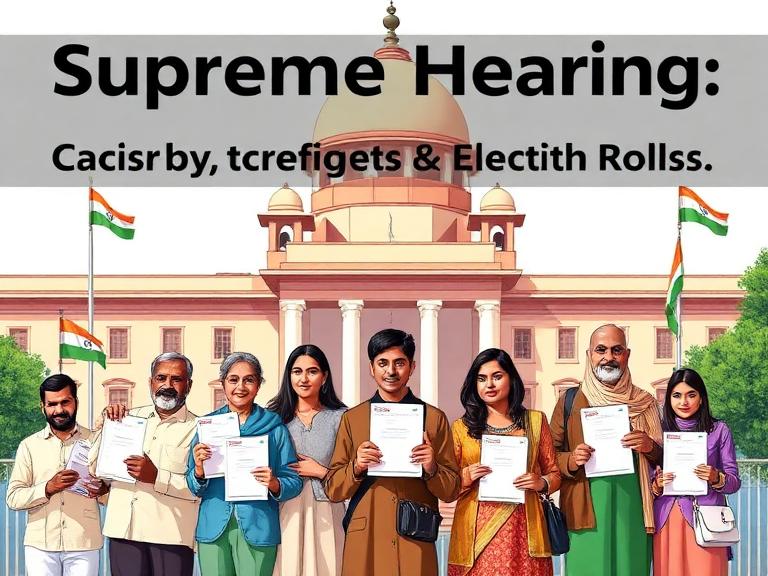
CAA-Protected Refugees awaiting citizenship under the Citizenship (Amendment) Act, 2019, face a Supreme Court ruling that determines their inclusion in electoral rolls during the Special Intensive Revision. On December 9, 2025, the Supreme Court of India heard a crucial petition regarding whether individuals eligible under the Citizenship (Amendment) Act, 2019 (CAA) can be included in electoral rolls during the ongoing Special Intensive Revision (SIR). The case specifically addresses whether refugees and persecuted minorities from neighboring countries—who have applied for Indian citizenship under CAA but have not yet received certificates—should be allowed to vote.
CAA-Protected Refugees are at the center of a Supreme Court hearing that has profound implications for citizenship rights, electoral inclusion, and the protection of persecuted minorities. The Court’s preliminary statement, emphasizing “first acquire citizenship, then voter status,” underscores the legal and administrative challenges surrounding this issue.
Understanding the Citizenship (Amendment) Act, 2019

What is the CAA?
CAA-Protected Refugees benefit from the Citizenship (Amendment) Act, 2019, which amended the Citizenship Act of 1955 to provide a pathway to citizenship for certain religious minorities from Pakistan, Afghanistan, and Bangladesh. The Act specifically covers Hindus, Sikhs, Buddhists, Jains, Parsis, and Christians who entered India on or before December 31, 2014.
CAA-Protected Refugees benefit from relaxed residency requirements under the Citizenship (Amendment) Act, 2019, which shortens the period needed for naturalization. However, being eligible under CAA does not automatically grant citizenship. Each application must still be verified and approved by authorities before the individual becomes a formal Indian citizen.
Who Are Affected?
The population affected by this law mainly includes CAA-Protected Refugees, persecuted religious minorities who migrated to India from neighboring countries. Many of these refugees have submitted their citizenship applications under the CAA, but delays in processing have left them in legal limbo. As a result, they are neither full citizens nor recognized foreign nationals, creating a gray area regarding their eligibility for voting.
The Supreme Court hearing is significant because thousands of such applicants are awaiting decisions, and the timing of electoral rolls under SIR coincides with their pending applications.
The Special Intensive Revision (SIR) of Electoral Rolls
Purpose of SIR
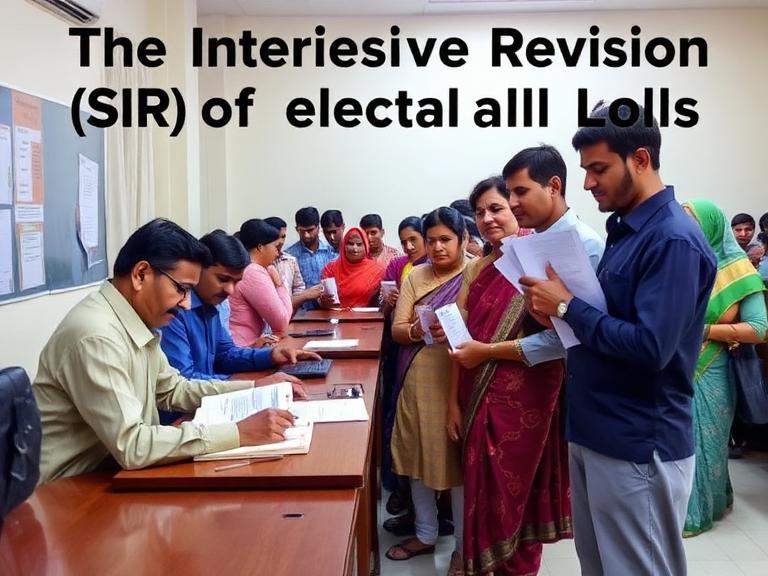
The Special Intensive Revision (SIR) is an exercise by the Election Commission of India (ECI) to update, verify, and clean electoral rolls ahead of upcoming elections. SIR involves verifying voter details, removing duplicate or invalid entries, and including newly eligible voters.
Citizenship Verification in SIR
While the SIR focuses on maintaining updated electoral rolls, the inclusion of CAA-Protected Refugees requires verified proof of Indian citizenship. Only citizens are legally entitled to vote in India, which creates a challenge for these refugees who have applied for citizenship under the CAA but have not yet received formal certificates.
The Supreme Court has emphasized that the ECI cannot unilaterally recognize applications under CAA as proof of citizenship, as this may compromise the legal requirement that only fully verified citizens can vote.
The Petition Before the Supreme Court

Who Filed the Petition
The petition was filed by a non-governmental organization on behalf of CAA-Protected Refugees, seeking their provisional inclusion in the voter list during the SIR. The petitioners argued that pending citizenship applications for these refugees should be treated as temporary proof of eligibility, at least to prevent their disenfranchisement.
Main Arguments
The key arguments of the petition included:
- Protection of Persecuted Minorities: Many applicants have fled persecution and have resided in India for years. Excluding them from electoral rolls during SIR could result in social and political marginalization.
- Acknowledgement Receipts: The petitioners argued that the receipts issued during CAA application submissions should serve as provisional proof of citizenship for inclusion in the voter list.
- Delay in Processing: There are claims of backlogs in citizenship application processing, and without provisional inclusion, many refugees risk being excluded from voting indefinitely.
- Humanitarian Considerations: Denying voter rights to refugees awaiting citizenship could be seen as discriminatory and unjust, especially when the law itself is designed to protect persecuted minorities.
The petition sought a judicial direction to the government and ECI to include these applicants provisionally in the electoral rolls until their citizenship applications are finalized.
Supreme Court’s Observations

During the hearing, the Supreme Court made several key observations:
- Citizenship Must Precede Voting Rights: The Court clearly stated that only confirmed citizens are eligible for inclusion in voter lists. Simply being eligible under CAA or having applied for citizenship does not guarantee electoral rights.
- Verification of Claims: Each CAA applicant’s claim must be verified, including their religion, country of origin, date of entry into India, and compliance with all conditions of the Act.
- Acknowledgment Receipts Insufficient: The Court indicated that receipts issued at the time of application cannot substitute for formal citizenship certificates.
- No Judicial Timeline for Citizenship Processing: The Court did not set any specific deadlines for disposal of pending citizenship applications, leaving administrative timing to the authorities.
- Need for Legal Clarity: The Supreme Court emphasized that allowing provisional inclusion without verification could compromise the integrity of electoral rolls.
The bench, comprising Chief Justice Surya Kant and Justice Joymalya Bagchi, highlighted the legal principle: “First acquire your citizenship, then voter status.”
Legal and Constitutional Considerations

Citizenship vs Electoral Rights
In India, citizenship is a prerequisite for voting. The Citizenship Act, 1955, and its amendments, including CAA, define legal pathways for naturalization, but until an application is approved, the individual does not enjoy full citizen rights.
Electoral rights are governed by separate laws, and the ECI requires verification of citizenship before inclusion in voter lists. The Supreme Court’s position reinforces this separation: eligibility to vote cannot be assumed based solely on CAA applications.
Risk of Disenfranchisement
While the law maintains strict citizenship requirements, there is a real risk that vulnerable communities may be disenfranchised due to administrative delays. Persecuted minorities awaiting citizenship certificates may lose their right to vote, even if they have lived in India for decades.
Balancing Inclusion and Electoral Integrity
The Court faces a delicate balance:
- Inclusion and Social Justice: Protecting refugees and persecuted minorities from disenfranchisement and social exclusion.
- Electoral Integrity: Ensuring that only verified citizens are included in voter rolls to maintain the credibility of elections.
The Court’s observations reflect a cautious approach, prioritizing legal clarity and integrity while acknowledging humanitarian concerns.
Implications of the Decision
For CAA Applicants
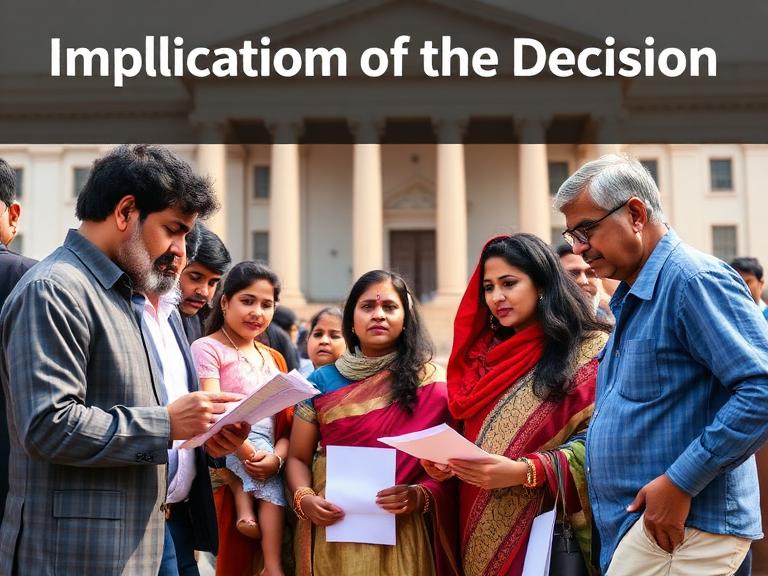
- Exclusion Until Certification: Unless citizenship is formally granted, CAA applicants cannot vote.
- Uncertainty: Delays in processing may extend their disenfranchisement, creating legal and social uncertainty.
- Civic Integration: Prolonged exclusion could hinder integration of refugees into Indian society.
For Election Commission
- Verification Responsibility: The ECI must verify citizenship carefully and cannot treat CAA applications as automatically valid proof.
- Administrative Challenges: Excluding thousands of pending applicants could increase objections, litigations, and protests during SIR.
- Electoral Impact: In states with high numbers of CAA applicants, the composition of electoral rolls may be affected, influencing local politics.
For Government and Judiciary
- Administrative Pressure: The government may need to expedite processing of pending CAA applications to prevent widespread disenfranchisement.
- Policy Considerations: Future legislation may require provisions for provisional inclusion or safeguards for applicants awaiting citizenship.
- Constitutional Debate: The case underscores tensions between humanitarian protection, secularism, and equality versus legal formalism and electoral integrity.
Challenges and Criticisms

Delay in Citizenship Processing
- Pending applications create a backlog, and without fast-tracking, many eligible refugees may miss the SIR cut-off.
- Judicial reluctance to set processing deadlines exacerbates uncertainty.
Risk of Statelessness
- Exclusion from voter rolls without final citizenship could effectively render some refugees politically invisible, despite residing in India for years.
Electoral Integrity vs. Humanitarian Inclusion
- Granting provisional voter rights could risk fraud or misuse, while strict adherence to citizenship verification may exclude genuine refugees.
- Policymakers and the judiciary must balance rule of law with social justice.
CAA-Protected Refugees awaiting citizenship under the CAA face a Supreme Court ruling on their inclusion in electoral rolls. More details on the Supreme Court of India and Election Commission of India websites.
For more details on legal provisions, see our article on Amid Escalating Tensions With Japan, China Seeks Diplomatic and Strategic Support From France