


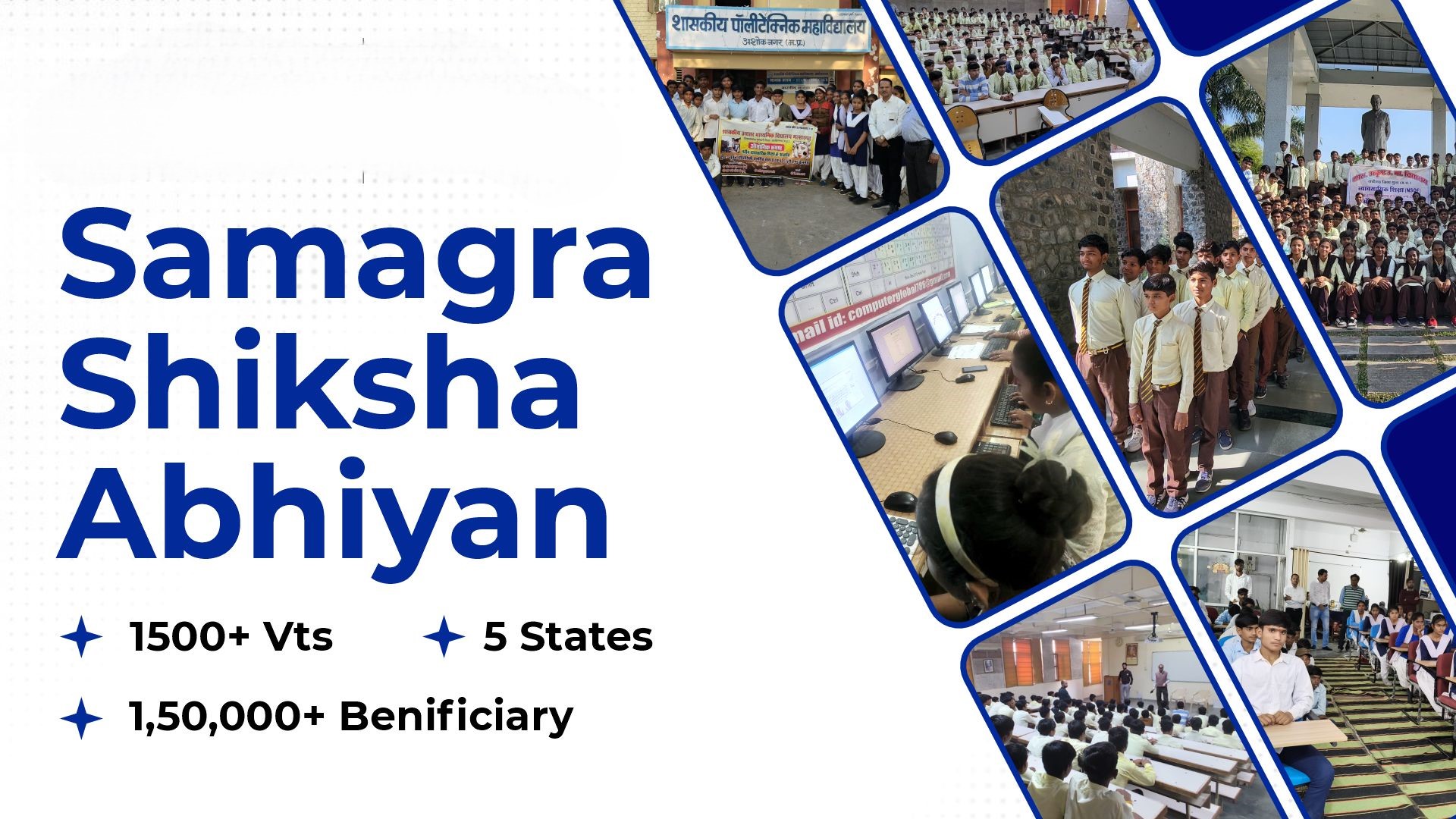
The Samagra Shiksha Scheme is India’s flagship and most comprehensive programme for strengthening school education from pre-primary to Class XII. It was first introduced in 2018 after the Union Budget 2018–19 announced that school education would be treated as a holistic system instead of fragmented stages. As a result, three major education schemes — Sarva Shiksha Abhiyan (SSA), Rashtriya Madhyamik Shiksha Abhiyan (RMSA), and Teacher Education (TE) — were combined into one unified mission.
This combined scheme is closely aligned with Sustainable Development Goal-4 (SDG-4), which aims to provide inclusive and equitable quality education for all. After the launch of the National Education Policy (NEP) 2020, Samagra Shiksha was further revised to match the new educational priorities—such as foundational learning, holistic assessment, digital learning, and inclusive classrooms.
The Cabinet Committee on Economic Affairs has approved its continuation from 1 April 2021 to 31 March 2026, with a massive financial outlay of ₹2,94,283.04 crore. The scheme covers 11.6 lakh schools, 15.6 crore students, and nearly 57 lakh teachers, making it one of the largest school education missions in the world.
Important Dates
Since Samagra Shiksha is an ongoing centrally sponsored scheme, it does not follow a typical recruitment-style timeline. However, the implementation cycle is approved for:
- Start Date: 1 April 2021
- End Date: 31 March 2026
- Current Status: Active and under implementation across all States and Union Territories.
Application / Participation Fee
There is no application fee for schools, teachers, or students to receive benefits under the Samagra Shiksha Scheme.
All assistance—such as textbooks, uniforms, digital tools, training, vocational labs, and infrastructure support—is provided free of cost under the norms of the scheme.
Scheme Features
Below are the major features of the Samagra Shiksha Scheme, simplified and presented point-wise:
Universal Access & Infrastructure
- Focus on ensuring schooling access for every child up to Senior Secondary level.
- Strengthening of school buildings, classrooms, laboratories, libraries, boundary walls, drinking water, and sanitation.
- Retention support for children who are at risk of dropping out.
Foundational Literacy & Numeracy (NIPUN Bharat)
- National Mission to ensure children achieve reading, writing, and numeracy ability by Grade 3 (latest by Grade 5).
- Provision of Teaching-Learning Material (TLM) – up to ₹500 per child per year.
- Assessment support: ₹10–20 lakh per district.
- Teacher training under NISHTHA for foundational learning.
Early Childhood Care & Education (ECCE)
- Training for Anganwadi workers and pre-primary teachers.
- Support for pre-primary sections in Government schools.
- Learning material for indigenous toys and play-based activities (₹500 per child annually).
Rights of Children (RTE Act Support)
- Makes sure every child between 6 and 14 years old gets free, mandatory schooling.
- Uniforms, textbooks, and other entitlements provided through Direct Benefit Transfer (DBT) for quicker delivery.
Quality Enhancement & Innovation
- Introduction of Holistic Progress Card (HPC) for 360° assessment.
- Bag-less days, internships with local artisans, school complex structure.
- Support for PARAKH (National Assessment Centre).
- Extra sports grants for schools with medal winners at national Khelo India levels.
Inclusion & Gender Equity
- Upgradation of all Kasturba Gandhi Balika Vidyalayas (KGBVs) to Class XII.
- Enhanced support for Girls’ Hostels — ₹40 lakh per annum.
- Installation of sanitary pad vending machines and incinerators.
- Special stipend for CWSN girls – ₹200 per month for 10 months.
- Every year, special identification camps are held for children with special needs (CWSN).
Secondary Education Support
- Universalization extended up to senior secondary.
- Students can choose subjects instead of streams.
- Transport facility at ₹6000 per child per year.
- Support of ₹2000 per grade for SC/ST/disabled out-of-school children to complete secondary education through NIOS.
Digital Learning & ICT
- ICT labs, smart classrooms, digital boards, virtual classrooms, and DTH channels.
- Digital teaching-learning content development and teacher training for ICT.
Vocational Education
- Available in Government and Government-aided schools.
- Classroom-cum-workshop setup for vocational hubs.
- Emphasis on internships, exposure visits, and convergence with other government departments.
Teacher Education & Training
- Strengthening SCERTs, DIETs, and BITEs.
- New SCERTs can be established; new DIETs allowed up to districts created by 31 March 2020.
- In-service training for teachers from pre-primary to Class XII.
Eligibility / Criteria (Point to Point)
The Samagra Shiksha Scheme is not a recruitment process, so eligibility criteria apply to beneficiaries in different categories:
Eligibility for Students
- The child must be studying in a Government or Government-Aided school.
- Students from pre-primary to Class XII can receive benefits.
- Special priority for socially and economically disadvantaged groups such as SC, ST, minorities, and CWSN.
Eligibility for Teachers
- Government and aided school teachers from pre-primary to senior secondary levels.
- Eligible for training under NISHTHA, professional development, digital training, and orientation programmes.
Eligibility for Schools
- All Government, Local Body, Tribal Welfare, and Aided schools.
- Schools must follow basic administrative norms and provide data under UDISE+.
Institutional Eligibility
- SCERTs, DIETs, BITEs, BRCs, CRCs, and school management committees are key implementation bodies.
Pay Scale / Financial Support
Samagra Shiksha does not define a pay scale for positions like government jobs. Instead, it includes financial assistance for salaries of existing teachers and support for scheme implementation.
Financial Benefits Under the Scheme
- Teacher Salary Support:
Central and state governments jointly fund salaries of teachers appointed under Samagra Shiksha norms. - KGBV Hostels (Type IV):
Financial support increased to ₹40 lakh per annum for Classes IX–XII. - Transport Allowance:
₹6000 per student per year. - Stipend for CWSN Girls:
₹200 per month for 10 months. - ECCE Learning Material:
₹500 per child per year. - Foundational Learning TLM:
₹500 per child annually + ₹150 per teacher + district-level assessment support. - Sports Support:
Extra ₹25,000 per school for national-level medal achievements.
The scheme does not pay students or teachers individually like a scholarship or recruitment job. Instead, it funds educational resources, infrastructure, training, and support systems.
Selection Process
There is no selection exam or recruitment process for students or teachers to receive benefits. Instead, the scheme is implemented through:
Identification-Based Selection
- Students are identified through the school system using UDISE+ data.
- CWSN students are identified through annual block-level camps.
Institutional Planning
- Districts submit annual plans based on local needs.
- SCERTs, DIETs, and BRCs coordinate training and academic support.
Monitoring & Evaluation
- Monitoring through KPIs (Key Performance Indicators).
- Social audit covering at least 20% schools each year.
- Regular assessment through PARAKH and state-level assessment cells.
There is no competitive selection—benefits are automatically provided to eligible schools and students.
Application Process
Since this is a scheme for educational improvement, the application process is administrative and handled by states. Students and teachers do not apply individually.
For Students
- Enrol in a Government or Government-aided school.
- Schools automatically include students in Samagra Shiksha benefits such as textbooks, uniforms, digital learning tools, and scholarships.
For Schools
- Update school data regularly on UDISE+ portal.
- Submit annual school development plans to the district office.
- Participate in audits, evaluations, and reporting.
For Teachers
- Attend training as scheduled by DIETs, SCERTs, and Block Resource Centres.
- Participate in NISHTHA and FLN modules delivered through online/offline modes.
Administrative Process (Internal)
- States prepare annual work plans and budgets.
- Proposals are approved by the Project Approval Board (PAB).
- Funds are transferred to state societies and then to districts/schools.
No public application form is required.